It is a phone number, not a service
A hotline printed in the induction pack and forgotten. Very few people will dial a stranger from an open-plan office, and almost nobody keeps the number when the poster comes down.
Most EAPs in Nigeria are a hotline number nobody dials. This one lives in an app your staff already have, staffed by 100+ licensed Nigerian therapists — video, voice or chat, in five languages, from ₦2,250 per employee per month.

An employee assistance programme — an EAP — is a benefit an employer pays for that gives staff confidential access to mental health and personal support: therapy, counselling, crisis help and practical advice, at no cost to the employee.
The employer funds the programme and gets usage and spend reporting. The employee books privately — no referral, no manager sign-off — and what happens in a session stays between them and their therapist.
In Nigeria that is usually priced per employee per month, and it sits alongside — not inside — your HMO cover.
Your company covers the programme as a benefit. Staff book at no cost to them, so money is never the reason someone puts off getting help.
No form to hand in, no manager to tell, no HR referral. Your employee opens the app, picks a therapist and books.
HR sees enrolment, sessions and cost — enough to run the budget. Which therapist the employee saw, and everything said in the room, stays out of your dashboard.
Buying an EAP is easy. Getting staff to use one is the entire job, and it is where most programmes quietly fail. Four reasons come up again and again.
A hotline printed in the induction pack and forgotten. Very few people will dial a stranger from an open-plan office, and almost nobody keeps the number when the poster comes down.
Offshore call centres route Lagos staff to counsellors who have never had to explain black tax, a landlord asking for two years up front, or a japa decision splitting a family.
If the referral runs through HR, or the invoice carries a name, people stay quiet. Confidentiality has to be structural, not a promise in a policy document.
Nigerian teams work late and do not only think in English. A programme that closes at 5pm on weekdays is closed exactly when people need it.
One plan per employee, per month. No per-session invoices to approve, no counting who called.
Fifty-minute sessions by video, voice or chat with licensed therapists your employee chooses themselves.
English, Yoruba, Igbo, Hausa and Pidgin. People say more about home in the language they use at home.
Same-day booking where a therapist has space, plus evening and weekend appointments so nobody books therapy in work hours.
The programme lives in an app your team installs once. No hotline to remember, no desk phone required.
Sessions for the people who have to handle it: how to raise a concern with a struggling report, and what to do next.
Team workshops and group sessions, online or at your office, on stress, burnout and the things your staff keep raising.
Mood tracking, breathing exercises and guided meditations in the same app, for the weeks when a session is not booked.
Enrolment, sessions, attendance and spend in one place, so you know whether the benefit is being used well before renewal.
If your current provider routes staff to an offshore call centre, this is the difference your people will feel on the first call.
This is the question your staff will ask first, and the one that decides whether anybody books. Here is the honest answer, so you can put it in the launch email word for word. Because your organisation pays per session, a booking has to be attributable for billing — so the dashboard does show which enrolled employee used the benefit. The clinical side never leaves our servers.
Enough to run the budget and prove the programme is working.
Not on request, not at renewal, not in an incident review.
Screens from the corporate admin your HR and finance leads get on day one, running against a demo organisation.
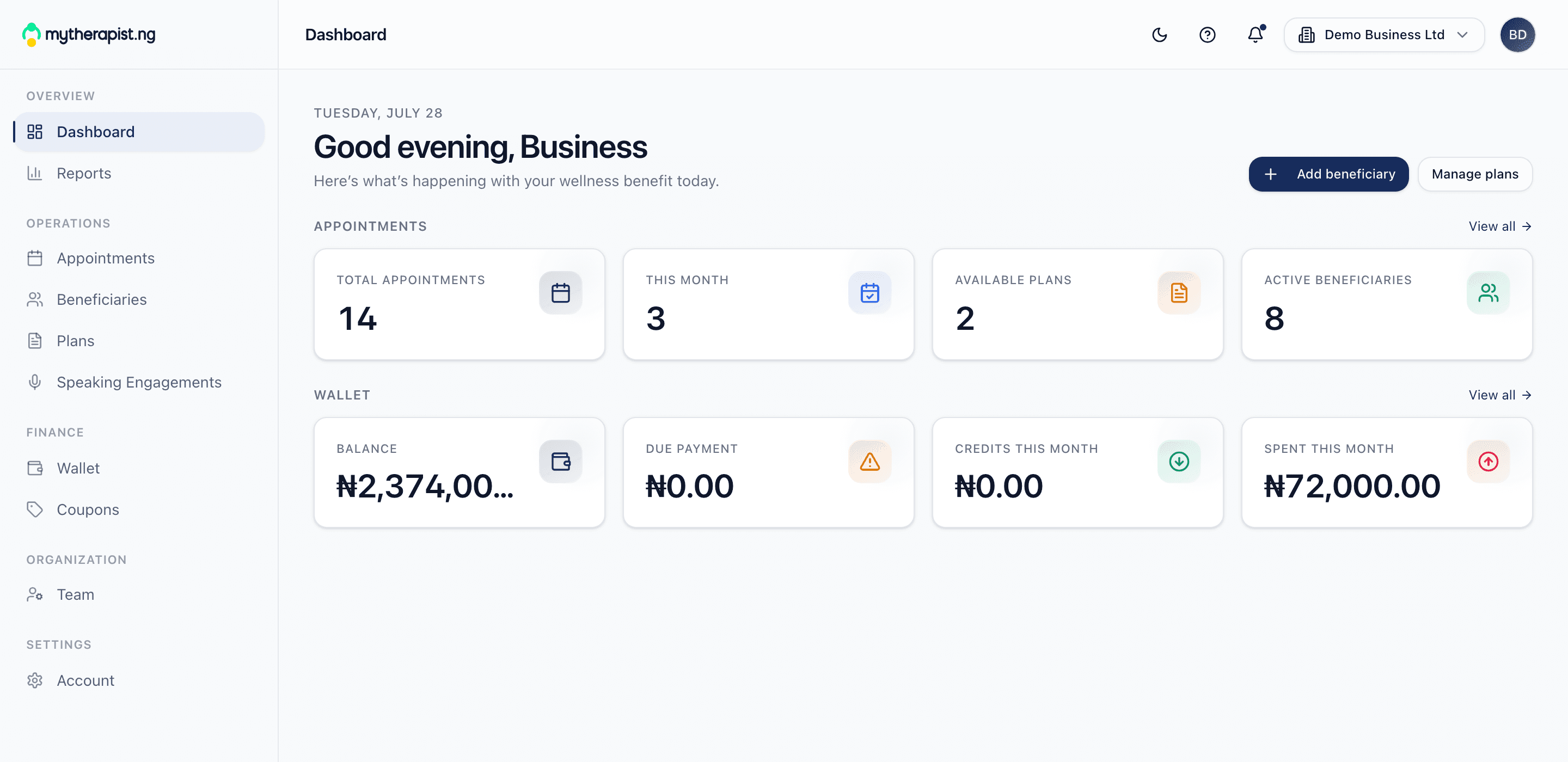
The first screen your HR lead opens. Sessions booked, how many landed this month, plans running and how many employees are actively enrolled — beside the wallet balance and what has been spent this month. Nothing here needs a report request or a support ticket.
Untreated stress is estimated to cost Nigerian employers around ₦200,000 per employee per year in absence, presenteeism and turnover. Set that against what an EAP actually costs and the maths gets simple.
Estimates only, for budgeting conversations. The ₦200,000 per-employee figure is an industry estimate of the annual cost of untreated workplace stress, not a guarantee of savings.
Per employee, per month. Longer billing cycles cost less per employee — the saving is shown on each plan.
A working EAP for teams putting one in place for the first time.
Where most Nigerian employers land — cover and budget balanced.
For employers treating mental health as core infrastructure.
Larger rosters, executive cover and dependant plans are quoted against your headcount — there are four further tiers above Premium. See the full plan table on our business page, or read how we work with Nigerian HMOs.
Your HR team does the first call and the launch email. We do the rest.
Thirty minutes on your headcount, where your people sit, and what HR is already seeing. You leave with a plan recommendation and a price.
Day 1We confirm the plan, the billing cycle and the invoice. No long-term lock-in — monthly plans cancel any time.
Days 2–3We brief your staff, send the invitations and set up your HR dashboard. Your team downloads the app and can book the same day.
Days 4–7Monthly reporting, a named contact for HR, and a check-in before renewal so the budget line is defensible.
OngoingYour staff are not going to explain Lagos traffic, black tax or a japa decision to a counsellor in another time zone. Browse the roster your employees would be booking from — therapists by language or therapists by city.
Sessions in Yoruba, Igbo, Hausa and Pidgin as well as English — filterable before your employee books.
Every therapist on the roster is a licensed Nigerian practitioner, with qualifications verified before they take a session.
Plenty of staff will type long before they will talk. Chat therapy removes the hardest step for first-timers.
Lagos, Abuja, Port Harcourt, Ibadan, Kano and everywhere between — plus staff working from abroad, on the same plan.
“We are having a Mental Health session at the office (@tryselar) with Mytherapist.ng, and if I say this session wasn't needed, I would be lying! Vanessa (the therapist assigned) is great at what she does.”
“The breathing exercises on this app kept me afloat on a day that seemed to be caving in on me. Highly recommend!”
An employee assistance programme (EAP) is a benefit an employer pays for that gives staff confidential access to mental health and personal support — therapy, counselling, crisis help and practical advice — at no cost to the employee. The employer funds the programme and gets usage and spend reporting; the employee books privately, without a referral or manager sign-off, and what is discussed in a session is never shared with the employer.
Nigerian EAPs are normally priced per employee per month. Mytherapist.ng starts at ₦2,250 per employee per month on the Standard plan, ₦5,750 on Enhanced and ₦10,500 on Premium, with lower effective rates on quarterly and annual billing. Everything is invoiced in Naira, so there is no FX exposure on your benefits line.
No. HMO mental health cover is usually a small number of sessions, gated behind a referral and a hospital visit, and it is rarely used. An EAP sits alongside your HMO: your employee books a therapist directly, in the app, without a referral and without their name reaching HR. Most of our clients run both, and we work with several Nigerian HMOs.
Because your organisation pays per session, a booking has to be attributable for billing — so your dashboard does show which enrolled employee used the benefit, when the session ran and what it cost. What it never shows is the clinical side: the therapist column is redacted server-side, so the therapist your employee chose never reaches your dashboard at all, and nothing said in a session, no session notes and no assessment or mood data is ever shared with an employer. Therapists are bound by Nigerian therapy licensing confidentiality requirements.
No. Once they are enrolled, they book in the app themselves — they pick the therapist, the time and whether the session is by video, voice or chat. There is no referral form, no manager sign-off and no conversation with HR before booking.
Most teams are live within 5–7 working days of the discovery call. That covers the plan agreement, HR dashboard setup, employee invitations and a briefing session. Staff can book their first appointment the same day the invitations go out.
We work with employers from 10 staff upwards. Below that, individual plans usually work out better — talk to us and we will tell you straight which one fits.
Yes, dependant cover can be added. It is priced per plan rather than sold as a fixed add-on, so raise it on the discovery call and we will quote it against your headcount.
Yes. Sessions are delivered by video, voice or chat, so location does not change what an employee gets. Nigerians working abroad book on the same plan and can still see a Nigerian therapist in their own language.
Mytherapist.ng is not an emergency service. If someone is in immediate danger, the crisis helplines listed at mytherapist.ng/helplines are the right first call. Within the programme, therapists follow escalation protocols and can route someone to urgent in-person care, and we will work with your HR team on a crisis policy during onboarding.
That is the failure mode of most EAPs, so it is the thing we watch. Your dashboard shows uptake from week one, and if activation is low we run re-launch comms and workshops rather than letting the programme sit unused until renewal.
AS SEEN ON





Tell us your headcount and we will come back with a plan, a price in Naira, and a launch date. Thirty minutes, no pressure, and a straight answer if we are not the right fit.